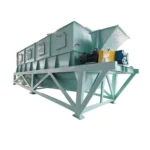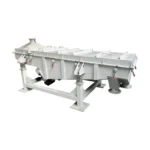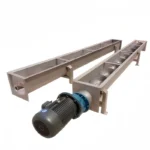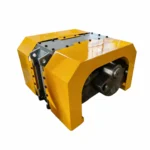




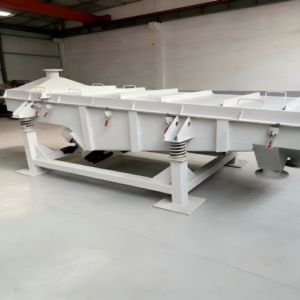
 A linear vibrating screen is a type of screening equipment that uses linear vibration to separate bulk materials according to particle size.
It is widely used in mining, aggregates, coal, construction materials, chemical processing, and other industries where efficient and continuous screening is required.
Unlike a rotary vibrating screen, which uses three-dimensional vibration, a linear vibrating screen moves material in a relatively straight line along the screen surface.
This motion allows the material to be transported forward while being separated through the screen openings.
How Does a Linear Vibrating Screen Work?
A linear vibrating screen typically uses two vibration motors mounted on the screen box as the vibration source.
When the motors rotate, they generate synchronized excitation forces. These forces cause the screen box and screen surface to vibrate in a linear direction.
As material is fed onto the screen:
Feeding → Linear Vibration → Screening → Size Separation → Discharge
Fine particles smaller than the screen openings pass through the screen, while larger particles remain on the screen surface and move toward the discharge end.
The vibration also helps distribute the material across the screen surface, improving contact between the material and screen media.
Main Components of a Linear Vibrating Screen
A typical linear vibrating screen consists of several key components:
Screen Box
The screen box supports the screen media and carries the material during the screening process. Its dimensions and structural design are selected according to the required capacity and application.
Screen Media
The screen media determines the final screening size.Different materials can be selected according to the application, including:
- Woven wire mesh
- Perforated plate
- Polyurethane screen panels
- Other customized screen media
Vibration Motors
Two vibration motors are commonly used to generate the linear excitation force. Motor specifications are selected according to the screen size, material characteristics, and required vibration intensity.
Springs and Supporting Structure
Springs support the vibrating screen box and isolate the vibration from the supporting structure.
Feed and Discharge Sections
The feeding section distributes material onto the screen surface, while the discharge section directs screened and oversize materials to their respective outlets.
What Materials Can a Linear Vibrating Screen Handle?
Linear vibrating screens can handle a wide range of bulk materials, including:
- Coal
- Sand
- Gravel
- Aggregates
- Minerals
- Construction materials
- Chemical materials
- Granular materials
- Powders
They can be used for both coarse screening and fine screening, depending on the screen media, machine configuration, and material characteristics.
Applications of Linear Vibrating Screens
Mining and Minerals
Linear vibrating screens can be used for screening and classification of crushed minerals and ores.
Coal
They can be used for coal screening, sizing, and material separation in coal handling systems.
Aggregates and Construction Materials
Applications include screening sand, gravel, crushed stone, and other construction materials into different size fractions.
Chemical and Industrial Materials
Linear vibrating screens can also be configured for screening granular materials and powders in various industrial processes.
Advantages of Linear Vibrating Screens
Efficient Screening
The linear vibration provides continuous material movement and effective contact between the material and screen surface.
High Processing Capacity
Large screening surfaces can be configured for applications requiring high throughput.
Continuous Operation
The equipment is suitable for continuous industrial production and can be integrated into automated processing lines.
Flexible Configuration
Screen dimensions, number of decks, screen media, vibration motors, and supporting structures can be customized according to application requirements.
Screening and Conveying
In addition to separating materials by particle size, the linear motion helps transport material toward the discharge end of the screen.
How to Choose a Linear Vibrating Screen?
Selecting the right linear vibrating screen requires consideration of several factors:
- Material Characteristics
Consider density, moisture, particle shape, abrasiveness, and whether the material is sticky or corrosive. - Feed Particle Size
The maximum feed size affects the screen structure and screen media selection. - Required Screening Size
The desired product particle size determines the screen mesh or aperture. - Processing Capacity
The required throughput determines the appropriate screen dimensions and configuration. - Number of Screening Decks
Multiple decks can be used when several particle size fractions are required. - Installation Requirements
The machine can be designed according to the available space and connection with upstream and downstream equipment.
Customized Linear Vibrating Screening Solutions
The size and configuration of a linear vibrating screen can be customized according to material characteristics, feed particle size, required screening size, processing capacity, number of screening decks, screen media, and installation conditions.
Depending on the application, the system can be configured as:
Feeding → Linear Vibrating Screening → Size Classification → Conveying / Collection
If you are selecting a linear vibrating screen for a specific material or processing capacity, the appropriate screen size, screen media, vibration force, and configuration should be determined according to the actual operating conditions.
Xinxiang Vibration Motor Co.,Ltd