



Dewatering Screen and Hydrocyclone: How Does the System Work?
In sand washing and mineral processing applications, removing excess water from fine sand is an important part of the process. A system combining a hydrocyclone, slurry pump, and dewatering screen is commonly used to separate, recover, and dewater fine materials.
Understanding how these machines work together can help operators choose the right equipment and achieve better results.
1. What Does a Hydrocyclone Do?
A hydrocyclone is mainly used for classification and separation of solid particles from slurry.
The slurry is fed into the hydrocyclone under pressure. Inside the cyclone, centrifugal force separates particles according to their size and density. Coarser and heavier particles move toward the underflow, while finer particles and water are discharged through the overflow.
In sand washing applications, hydrocyclones can help recover fine sand that might otherwise be lost with the wastewater.
2. What Is the Role of the Slurry Pump?
A slurry pump transfers the sand-water mixture from the washing process to the hydrocyclone.
Because the hydrocyclone requires a certain feed pressure to operate properly, the slurry pump needs to be selected according to the required flow rate, head, slurry characteristics, and hydrocyclone configuration.
For example, a system may use one slurry pump to feed two hydrocyclones, depending on the required capacity and operating conditions.
The pump and hydrocyclone therefore need to be considered as part of the same system rather than as completely independent pieces of equipment.
3. What Does the Dewatering Screen Do?
 After classification in the hydrocyclone, the underflow still contains a considerable amount of water.
This is where the dewatering screen comes into play.
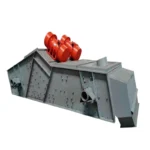
The material is fed onto the vibrating screen. Vibration allows water to pass through the screen openings while the sand moves toward the discharge end.
The result is a material with significantly reduced moisture content that can be more easily transported, stored, or used as a finished product.
A properly designed dewatering screen can therefore improve the handling and recovery of washed sand.
4. Why Is the Vibration Motor Important?
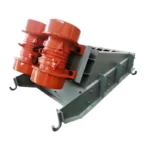
The vibration motor is one of the key components of a vibrating dewatering screen.
The motor generates centrifugal force through its eccentric weights. This force causes the screen box to vibrate, helping the material move across the screen while allowing water to drain through the screen surface.
The correct vibration force and motor configuration depend on several factors, including:
- Screen size
- Material capacity
- Material characteristics
- Moisture content
- Required dewatering performance
- Screen inclination
- Operating frequency
Using an appropriately sized vibration motor is important for achieving stable operation and avoiding unnecessary energy consumption or mechanical stress.
5. How Do the Three Machines Work Together?
A typical sand dewatering process can be summarized as:
Sand and water → Slurry Pump → Hydrocyclone → Dewatering Screen → Dewatered Sand
Each piece of equipment performs a different function:
| Equipment | Main Function |
|---|---|
| Slurry Pump | Transfers slurry to the hydrocyclone |
| Hydrocyclone | Classifies and separates particles |
| Dewatering Screen | Removes excess water from sand |
| Vibration Motor | Provides the vibration required by the screen |
The performance of the complete system depends on how well these components are matched.
For example, increasing the hydrocyclone capacity without considering the pump capacity or dewatering screen capacity may result in an unbalanced system.
6. How to Select the Right Equipment
Before selecting a hydrocyclone, slurry pump, or dewatering screen, several operating conditions should be considered.
Material Capacity
The required processing capacity is one of the first parameters to determine. Equipment should be selected according to the actual feed rate rather than simply choosing the largest available machine.
Particle Size
The size distribution of the feed material affects hydrocyclone classification and screen selection.
Moisture Content
The moisture content of the feed and the required moisture content of the final product are important when selecting a dewatering screen.
Slurry Characteristics
Density, solids concentration, particle size, and abrasiveness can all affect slurry pump selection and system performance.
Vibration Parameters
For a vibrating dewatering screen, vibration force, operating frequency, screen inclination, and motor power should be considered together.
Conclusion
A hydrocyclone, slurry pump, and dewatering screen can work together as an effective solution for sand washing and dewatering applications.
The hydrocyclone performs classification and fine sand recovery, the slurry pump provides the required slurry transportation and feed pressure, while the dewatering screen removes excess water from the recovered material.
The vibration motor is a critical component of the dewatering screen because it provides the excitation force required for material movement and water separation.
At Xinxiang Vibration Motor Co., Ltd., we manufacture vibration motors and vibrating screens for mining, aggregate, sand washing, and other industrial applications. We can also provide technical support for selecting suitable vibration motors according to the requirements of different vibrating equipment.
If you are designing a new dewatering system or looking for vibration motors for a vibrating screen, please contact us with your equipment specifications and operating requirements.