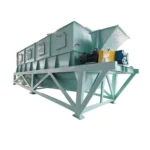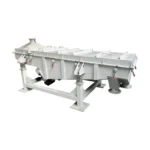




A circular gyratory screen is a high-efficiency screening machine designed for the fine and precise screening of powder and granular materials.
Unlike conventional vibrating screens, it uses a reciprocating gyratory motion to move material across the screen surface,
providing a long screening path and high screening accuracy.
It is widely used in chemical, food, pharmaceutical, mineral, ceramic, fertilizer, and other material processing industries,
particularly where fine screening, accurate classification, and high screening efficiency are required.
How Does a Circular Gyratory Screen Work?
A circular gyratory screen uses a driving system to generate a controlled gyratory motion of the screen box. The material enters the center or feeding area of the screen surface and gradually moves outward while undergoing repeated screening.
During operation, the material is continuously spread across the screen surface. Fine particles pass through the screen openings, while oversized particles move toward the discharge outlet.
The basic screening process is:
Feeding → Gyratory Motion → Material Stratification → Fine Screening → Size Classification → Discharge
The long material travel path and gentle screening motion help improve screening efficiency, especially when processing fine or relatively fragile materials.
Main Components of a Circular Gyratory Screen
Screen Box
The screen box contains the screening decks and provides the main working area for material separation. Its dimensions can be customized according to processing capacity and installation requirements.
Screen Media
The screen media determines the final separation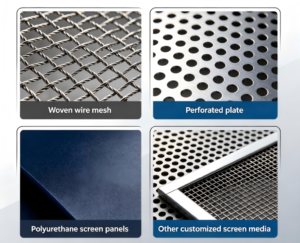 size. Different mesh materials and aperture sizes can be selected according to the material and application.
Common options include:
- Stainless steel wire mesh
- Carbon steel wire mesh
- Polyurethane screen panels
- Other customized screen media
Drive System
The drive system generates the gyratory motion required for material movement and screening.
Screen Decks
Multiple screening decks can be installed to separate material into several particle size fractions in a single machine.
Supporting Structure
The supporting and tensioning components maintain stable operation of the screen and ensure proper tension of the screen media.
What Materials Can a Circular Gyratory Screen Handle?
Circular gyratory screens are particularly suitable for fine and medium-sized powders and granular materials.
Typical applications include: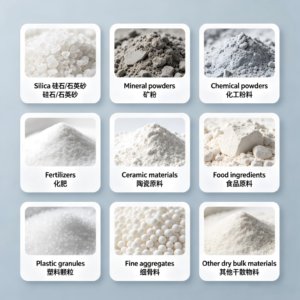
- Silica
- Mineral powders
- Chemical powders
- Fertilizers
- Ceramic materials
- Food ingredients
- Plastic granules
- Fine aggregates
- Other dry bulk materials
The actual application depends on the material’s particle size, moisture content, density, flowability, and required screening accuracy.
Applications of Circular Gyratory Screens
Fine Screening
The gyratory motion provides a long screening path and repeated contact between the material and screen media, making the equipment suitable for fine screening.
Particle Size Classification
Multiple decks can be used to separate materials into several particle size ranges.
Impurity Removal
The equipment can remove oversized particles and unwanted foreign materials from powders and granular products.
High-Precision Screening
The gentle and controlled screening motion is suitable for applications where consistent particle size distribution is important.
Advantages of Circular Gyratory Screens
High Screening Efficiency
The large effective screening area and long material travel path provide efficient separation of fine particles.
High Screening Accuracy
The controlled gyratory motion allows material to remain in contact with the screen surface for an extended period, improving the probability of fine particles passing through the mesh.
Gentle Material Handling
Compared with more aggressive vibration, the relatively gentle motion can help reduce unnecessary impact and material degradation.
Multi-Deck Configuration
Multiple screen decks can be used for simultaneous classification into several particle size fractions.
Large Processing Capacity
The large screening surface makes the equipment suitable for applications requiring higher throughput while maintaining screening accuracy.
Customized Design
The equipment can be customized according to screening area, number of decks, screen mesh, material characteristics, processing capacity, and installation requirements.
How to Choose a Circular Gyratory Screen?
Several factors should be considered when selecting a gyratory screen:
- Material Characteristics
Particle size, density, moisture, flowability, abrasiveness, and material shape all affect equipment selection. - Required Screening Size
The screen aperture should be selected according to the desired product particle size. - Processing Capacity
The required throughput determines the appropriate screening area and machine size. - Number of Product Fractions
Multiple decks can be used when several particle size ranges need to be separated simultaneously. - Screen Media
Different mesh materials and opening sizes can be selected according to the material and application. - Installation Conditions
The overall dimensions, feeding and discharge arrangements, and support structure can be customized to fit the existing production line.
Customized Gyratory Screening Solutions
Our circular gyratory screens can be customized according to material characteristics, feed particle size, required screening size, processing capacity, number of screening decks, screen media, and installation conditions.
A typical screening process can be configured as:
Feeding → Gyratory Screening → Fine Screening → Size Classification → Collection
For applications involving silica, mineral powders, chemical materials, fertilizers, ceramics, and other fine bulk materials, the screen configuration can be selected according to the specific production requirements.